

Mother Nature’s Other Face
She has a rather heartless side, as dogs in the field soon learn
Mother Nature is almost always depicted as a benign force that sustains life on our planet and inspires poets, artists and thinkers. Moments of solitude with her have been called sunshine for the soul. Indeed, John Ruskin, the 19th-Century English writer and philosopher, even went so far as to say that “Nature is painting for us, day after day, pictures of infinite beauty.”
However, Sporting, Hound, Working, Herding and probably the large Terrier folks have known for generations that Mother Nature (hereafter referred to as MoNa) also has a dark side that is not for the faint of heart. She is not always the benign, kindly, warm-hearted and nurturing mom depicted in the arts. Instead, she’s just as often an ornery, nasty-tempered and frequently evil old battleax who will happily kill you, given the slightest opening to do so.
MoNa has a lot of ammunition this mission — wind, rain, snow, sleet, lightning, earthquakes, tornadoes, hurricanes. But should her personal arsenal be unavailable, inconvenient, ineffective or inadequate to do the job, she harbors some fearsome critters perfectly willing to do her bidding and the killing for her.
In the broadcast world, there are what are known as PSAs, or public service announcements. The following stories should be viewed as sort of PSAs for dog folk who are thinking about doing field activities with their dogs but who may not exactly be rugged, outdoorsy types. What’s more likely is that quite a few field rookies have not had vast experience dealing with the fickleness of MoNa. So, these cautionary tales are presented to provide some inkling of the things she has in store for you, and which may help tilt the odds of survival for yourself and your dogs a bit more in your favor.
A friend, his champion Nova Scotia Duck Tolling Retriever Rex and one of the Toller owner’s hunting buddies had a truly harrowing experience hunting ducks on a prairie lake in Manitoba several years ago.
First, a few facts about prairies and prairie lakes, for those unfamiliar with either. The lakes are usually shallow, which means any wind at all can whip up some pretty impressive waves. The water can be damned cold, and if that sounds like the voice of experience, that’s because it is! The weather on the prairies can also turn from a lovely, soft autumn day to the most vicious sort of winter that puts your very survival at risk in a New York minute. (Again, if that sounds like the voice of experience ...)
Rex, his owner and their hunting partner encountered both.

Nova Scotia Duck Tolling Retriever Rex nearly drowned when his owner’s boat was swamped during a storm on a Manitoba prairie lake.
When they started out in the morning, it was a pleasant fall day, although Rex’s owner did notice some clouds in the west and a fiery red sunrise.
“As a 20-year Navy officer, much of it spent at sea on tin cans [destroyers], I should have remembered the old rhyme about red skies at morning,” he says. “Still, the weather forecast was for nothing more serious than a cloudy day, so this old sailor failed to heed the next words in the rhyme, and we paid for that failure. Before the first hour of hunting was over, it had clouded up and started to rain. Then the wind came up and the temperature started dropping.
“While we were hunting in a protected bay, I could see that the lake was getting pretty rough, but I figured we could make it to the lee side of the lake and then it wouldn’t be too bad going back to the landing.”
Rex had made several retrieves, and while it hadn’t seemed like the water was terribly cold, he was shivering so hard his owner wrapped a couple of decoy bags around the dog.
“Since we were close to our limit of ducks, in view of the deteriorating weather we decided to call it a day. We had barely finished picking up the decoys when the rain changed to snow and the wind picked up steam. Running the boat across the bay to the lee side, we were already taking water over the gunnels, so I handled the boat while Pete’’ — his hunting partner — “bailed water. We were still a hundred yards from the lee side when the outboard motor conked out.
“With no time to waste finding out why, I grabbed the oars and started rowing for the lee shore with every bit of my strength, but the best I could do in the wind, waves and the weight of water in the boat was keep us from losing any ground. Pete had to quit bailing and man one of the oars which meant water kept coming into the boat and none of it was being dumped back into the lake.”

A morning of retrieving ducks with a rising wind and waves had Rex shivering so hard his owner wrapped him in decoy bags to give the dog some protection from the wind and dropping temperatures — a compassionate act that nearly cost the dog his life.
Before they got to the lee side of the lake, with its calmer water behind the thick crop of reeds and cattails, the boat was nearly swamped, and Rex was having to swim. But he was fouled in the decoy bags and was fighting to keep his head above the water.
“I had to cut him free of the bags to save him, but by the time I got him free, what with dragging his coat through the water on the retrieves, battling the waves and wind and then the struggle to survive the decoy bag entanglement, he was pretty well spent.”
After what could only be described as herculean effort, they managed to reach the shelter of the lee shore, but with a boat full of water, an exhausted dog and two very wet, very tired hunters.
That, however, was not the end of their ordeal: They still had to get back to the landing where they had left the truck and boat trailer.
“We managed to push the boat deep enough into the reeds so we could get out and stand on the lake bottom to unload the decoys and ducks, put Rex on a muskrat house and dump the water out of the boat. But Rex was in tough shape.
“Fortunately, I found an old rain jacket tucked away in the bottom of my blind bag, which says something about the virtue of not cleaning out that bit of equipment too often, along with a thick cotton waffled underwear shirt. We wrapped the dog in the shirt and rain jacket so at least he wasn’t getting any wetter or colder. Once we had all the gear, birds and Rex reloaded, we managed to pole, row and sometimes wade our way back to the landing, but even with being in a somewhat sheltered area with a bit calmer water, it was a pretty grim task. Most definitely it was the longest half-mile I’ve ever traveled in my life.”
After they dried the dog, put him in the truck and wrapped him in two survival blankets the dog’s owner kept behind the seat for winter driving, the three of them — two hunters and a dog — crowded into the cab with the heater turned up to the max for about a half-hour. The heat, coupled with the sugar rush from some candy bars, finally allowed the hunters to regain enough energy to load the boat on the trailer and head home.
“Although he ordinarily ‘supervises’ everything I do, Rex indicated that we were on our own loading the boat, as he was not about to leave the warmth of the truck cab. His mama didn’t raise any dumb pups, that’s for sure.
“As for me, I did learn two lessons from the experience, and they’re probably something everyone who hunts should also heed,” the Toller owner says. “The first was to always keep a weather eye out, something I should have remembered from my time at sea. The other was to get a neoprene flotation vest for my dogs and make sure I never left home without it.”
When MoNa doesn’t have time to activate her own arsenal or is otherwise occupied harassing someone else, she can always call on one of the critters in her realm for help. In this instance she had apparently summoned a reserve in the form of a bull moose and ordered him to stomp or gore a Norwegian Elkhound owner and his dog, Olaf, for her entertainment.

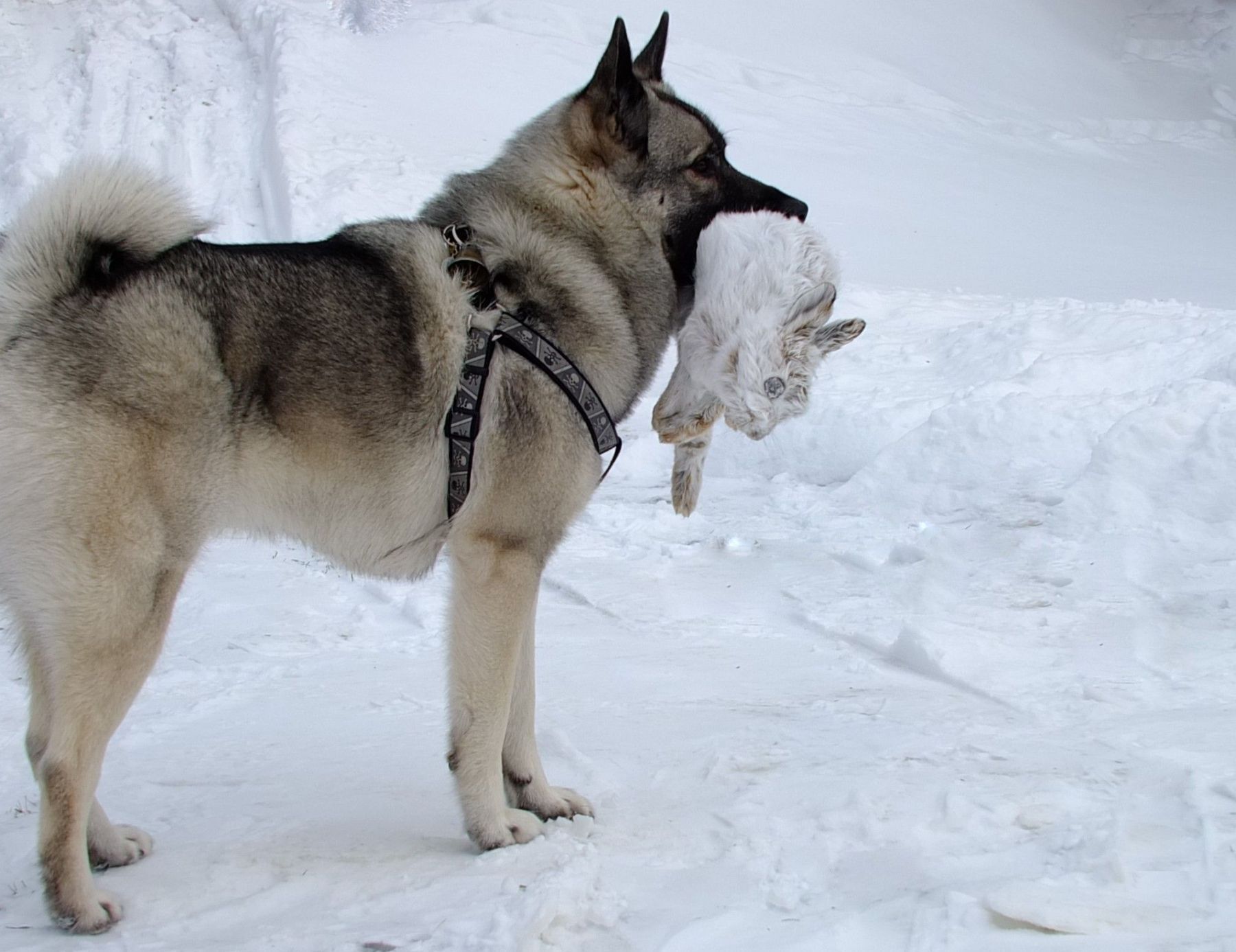
Much to his owner’s surprise, Olaf the Norwegian Elkhound was a good rabbit and grouse hunter.
The Elkhound, much to his owner’s surprise, had turned out to be a good rabbit and grouse dog, although he’s rarely used for grouse, as the owner’s “other breed” is a Wirehaired Pointing Griffon. So they were hunting both on land where the landowner had a deal with a paper company for the company come in every now and then to clear cut about 40 acres of mature aspen and then replant the trees, resulting in new-growth aspen buds, a favorite winter food for ruffed grouse, which meant grouse were plentiful, even in “down years” for the birds. The aspen tract also bordered a field of timothy that the owner grew for area thoroughbred-horse farms, so there was also an abundance of rabbits.
Unfortunately, aspen is also fine moose food, and unknown to either the Elkhound owner or the landowner, a very large bull moose along with a pair of cows had moved into the area to take advantage of the stand of young aspen, the nearby timothy and the wet meadow within the aspen stand.
Bull moose are not the most amiable members of the deer family at any time, but during the mating season, or rut, they get downright ornery, and the rut always coincides with at least part of the hunting season.
When the moose spotted Olaf, he was determined to drive the invader from his territory. He charged, and it was clear from the git-go that he wasn’t bluffing. Certainly, mayhem and most likely murder with both the dog and his owner as victims was uppermost in the moose’s mind.
Since there was no way he could outrun a charging moose and the birdshot in his shotgun would only serve to annoy the moose that much more if he tried to stop the charge by shooting him, at the last second the Elkhound’s owner jumped behind a tree and the moose overran him.
At the same time he took refuge behind the tree, he yelled, “Kennel” at Olaf, who was already running for the truck like someone had lit his tail on fire.
When he reached the truck, to his owner’s amazement — since the dog had never before indicated any great leaping ability — Olaf leaped through the open window on the driver’s side, then spun around and apparently started yelling insults at the moose, because the moose responded to the abuse by trying to tear the truck cab apart.
Discretion being the better part of valor, when the moose finally tired of the sport and wandered off, the Elkhound’s owner sneaked back to the truck and found Olaf sensibly hiding on the floor of the cab.
The lesson learned from the encounter?
“When I’m planning on hunting or just traveling on foot in an area for the first time during the summer or fall, especially in moose country, since a cow moose with calves can be as testy as a bull during the rut, it’s wise to do a little recon beforehand,” the Elkhound’s owner says.
It isn’t just hunters who run afoul of MoNa’s surrogates. A lady who has Labradors and one Kerry Blue Terrier named Flanders told a truly frightening tale about what happened to her on the retriever club’s grounds where she trains her Labs for the hunt tests.
“I found that the club’s grounds were wonderful just for giving my dogs a run,” she explains, “as the club members keep the grounds and the ponds free of the alligators that keep showing up in many of the ponds in my neighborhood, which makes letting the dogs off leash at home hazardous.”

A pause for a drink from a retriever club’s pond nearly was fatal for Flanders, a Kerry Blue Terrier, when a very large alligator, undetected by club members, charged out of the pond, intent on having a dog dinner.
Midway through a week that had been much warmer than normal for January, she was walking her dogs on the club grounds and had stopped to chat with some members who were training. During the “chat time,” her KBT wandered over to a pond for a drink.
Suddenly, there was a terrific commotion by the pond, and Flanders came racing away from the pond screaming and bleeding heavily from a front leg. One of the members tackled the terrified dog as he ran past the group and hustled him into the back of his nearby truck. At the same time, he yelled at Flanders’ owner to get herself and her other dogs into the truck.
The rest of the people in the training group also quickly retreated to their vehicles with their dogs as an enormous alligator came storming out of the pond. Undetected by members, the gator had moved into the club’s pond the previous fall, and the unusual January warmth had roused him from his winter stupor.

Flanders’ close encounter with the alligator caused his formerly gun-hating owner to become proficient with firearms.
Luckily, one of the members was licensed by the state to deal with troublesome gators, and he dispatched the beast, which was much too large to be relocated.
Flanders, fortunately, needed only some stitches, a massive dose of antibiotics and anti-inflammatories, some pain meds and a lot of TLC to recover. His owner says she needed a couple of good, stiff shots of bourbon before she stopped shaking.
It also taught her a valuable lesson.
“It convinced me that despite growing up in the city and in a home where ownership of a firearm was simply unthinkable, I needed to not only get one but also learn how to use it,” she says. “Much to my husband’s amusement, I took the state’s department of natural resources’ gun-safety course, and I also spent several months taking shooting lessons at a local gun club from an instructor who was very good at teaching women.
“I decided I needed to acquire this skill not only to protect my dogs but also my kids when we were in the neighborhood parks. My kids and my dogs are not going to be a meal for some gator if I can prevent it. If that meant I had to put aside my dislike for and fear of guns, so be it. There’s such a thing as establishing priorities!”

A bull moose charging Olaf and his owner on a grouse and rabbit hunt had mayhem and quite likely murder uppermost in his mind.
These stories are not meant to discourage anyone from taking their dogs into the field. Quite the contrary. These tales from nature are recounted simply to remind everyone that it’s wise to adopt the U.S. Coast Guard’s motto — Semper paratus, or “always ready” — when you go afield with your dogs, because trouble may be lurking just over the horizon, behind the next tree or hiding in a seemingly serene pond.
There is an old saying in the military: “Have a plan. Have a second plan because the first one won’t survive initial contact with the enemy.”
That’s good advice, even when the “enemy” is MoNa.