

An Auction Selection
From pottery to watercolors, some desirable finds
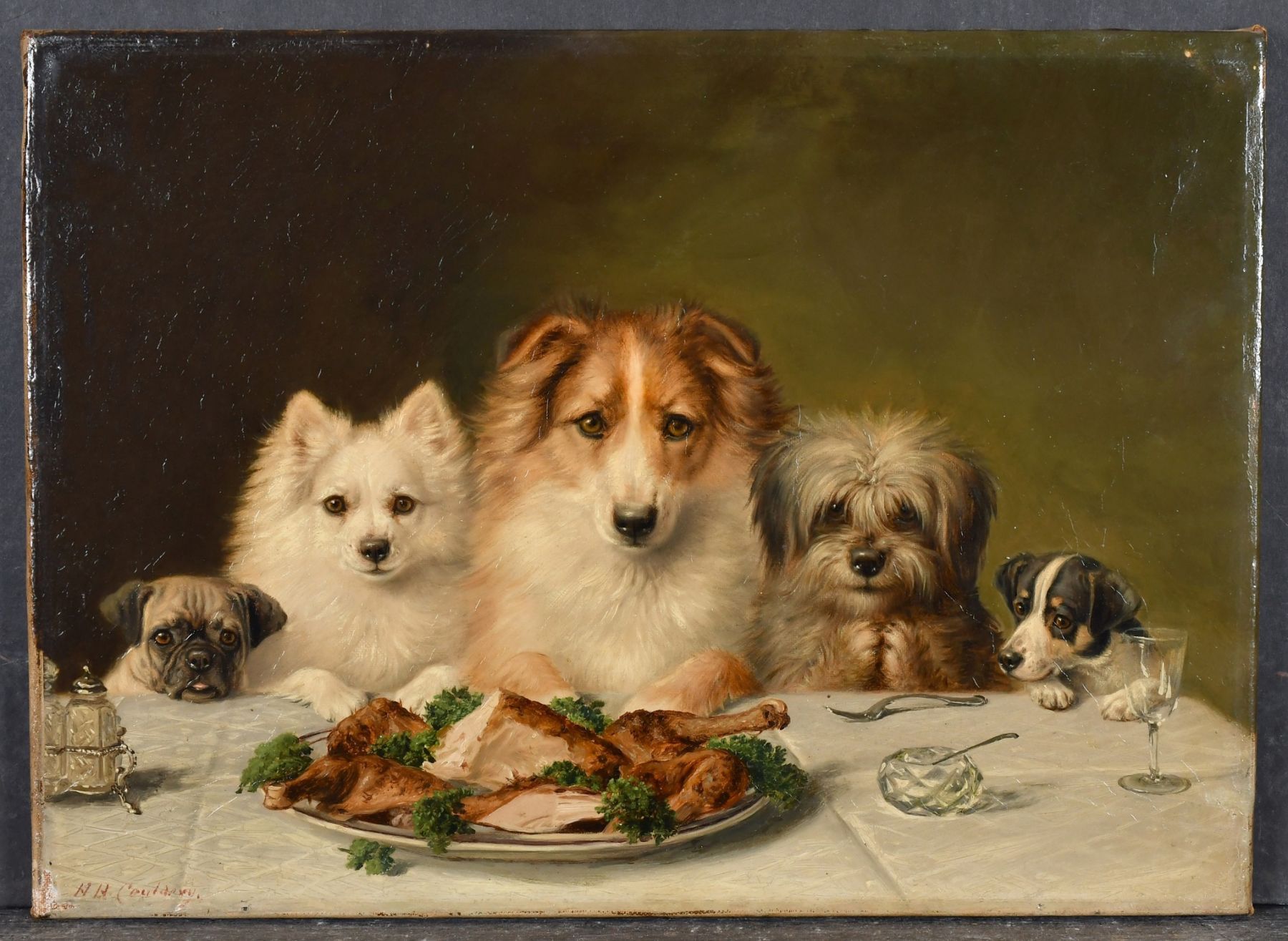
 The art market can be fickle, and if the demand for lesser “decorative” dog art may have declined, then some prices achieved at auction recently indicate that if the subject is what is wanted, there is still a strong demand.
Obidiah Sherratt was an elusive potter working in the Staffordshire Potteries in the early 19th Century. It is not known for certain that he was a figure potter, for the only two known wares bearing his name are frog mugs.

Despite this, many figures with a particular vigorous earthiness are traditionally attributed to Sherratt, or “in the style of” or “Sherratt type.” One of the most popular is the bull-baiting group shown variously posed on varying bases, but always there is a hatted man, a bull and two Bulldogs — one being tossed, the other gripping the bull’s head. Gorringe’s sold one from circa 1830, cataloged as “of Obidiah Sherratt type” with some restoration, for £3,600 against a top estimate of £1,200.

Alexandre-François Desportes (1661-1743) was one of France’s leading painters of the period who specialized in animals. He was much in demand and did commission work for King John III Sobieski of Poland and of favorite hunting dogs for both Kings Louis XIV and XV of France. Parker Auctions sold a typical Desportes sporting picture; the spotted dog with a dead partridge and woodcock at its feet was in an extensive landscape of a lake and distant mountains beyond. Against a top estimate of £12,000-£16,000, a U.K. collector had to go to £32,000 to secure it.

Horatio Henry Couldery (1832-1918) was a painter noted especially for his depiction of cats and dogs in domestic scenes, usually sentimental to appeal to Victorian tastes and often anthropomorphic. “Grace before Meat” had a selection of five dogs at the dining table waiting patiently to get to a tempting plate of meat on the table. It sold within estimate for £5,000.

Work by Thomas Blinks (1860-1912) appears regularly at auction, and I regularly feature his work. Also sold by Parker’s was an oil sketch of Basset Hounds for £280. Recent Parker auctions have included working studies by Blinks, and all managed to sell. They are put in by a vendor who bought a quantity that originated from the artist’s studio sale. If collectors dream of owning a finished work by Blinks but cannot afford to, his sketches are a very good and affordable substitute.
Tennants sold a mix of dog-related lots in a recent sale dominated by studies of Foxhounds put together by the wealthy art collector Captain Edward “Teddy” Cazanove, who was brought up by his New York-born mother Edith. Cazanove was a member of an old city banking family, but he turned his back on banking to devote his life to hunting, becoming a Master of Hunts in England, Scotland and Ireland.

From his collection was a watercolor and body color study of the Ledbury Hounds by Cuthbert Bradley (1861-1943) that sold above estimate for £420. It was the working sketch for the artist’s 1913 oil of the same subject matter. It was commissioned by Sir George Bullough MFH and depicts many of the famous hounds in the pack at that time. The original was offered for sale at Bonhams’ “The Dog Sale” in New York in 2009 with expectation of up to $20,000, but failed to sell.

The cast-iron Deerhound table of four life-size parcel-gilt sitting hounds supporting a top veneered to look like marble made by the Coalbrookdale Foundry for the 1855 Paris International Exhibition is the most important piece of cast-iron decorative dog art from the 19th Century. It was never repeated, but cast-iron models of Deerhounds appeared in the pattern book and do from time to time appear at auction. Two third-size sitting hounds on oval bases offered by Tennants sold for £450.

David Cemmick is a contemporary sculptor living in the Lake District of northern England. Television appearances and conservation work molded his early career. He trained in animal anatomy and has studied at the Barcelona Academy of Arts. His passion is wild places and the creatures that inhabit them. His half life-size bronze of an Irish Wolfhound named Hector standing foursquare on a rectangular base was number one from an edition of nine and sold for £700.

Among the pioneers of the Bull Terrier after World War II was the partnership of Miss Montague-Johnstone and Miss Margaret Williams. Many successful dogs came for the Romany kennel, including Ch. Romany Rhinestone, considered one of the dogs to have been the foundation of the breed postwar. The Colored Bull Terrier at this time was very much the poor relation, and the partnership did much to bring the Colored to the fore. Tennants sold a head study of the Colored Romany Reefer for a mere £60.

Greyhounds vie with Foxhounds for their popularity and regularity in 19th-Century art. Most of the Foxhound pictures in Tennants sold well, and a selection of Greyhound pictures offered by Clevedon Auctions all sold above estimate. The Greyhounds had come to auction from a private collection in Bristol; it had previously been removed from a country house in northeast England, the ancestors having been the owners at one time of these dogs.
The two most interesting were a portrait of the black dog Greentick with an extensive landscape beyond attributed to the 19th-Century artist James Armstrong (£1,600) and a double portrait attributed to John Charlton (1849-1917) of the littermates Gay City and Miss Glendyne, also with an extensive landscape beyond and with the Iron Age fort of Shaftoe Crags in the far distance (£2,200).
Greentick won 48 courses and only lost eight throughout his coursing career. He was probably the most influential Greyhound sire of all time, one of his children being Fullerton, the greatest Greyhound that ever ran.
The red dog, Gay City, won 27 of his 36 courses and was runner-up twice for the Great Champion Stakes, worth £2,000. The brindle bitch, Miss Glendyne, only lost two of her 23 courses over five seasons. She divided the Waterloo Cup in 1885 and won it outright in 1886.
