

Time in a Bottle
If you could turn back the clock, what would you do differently in the dog sport?
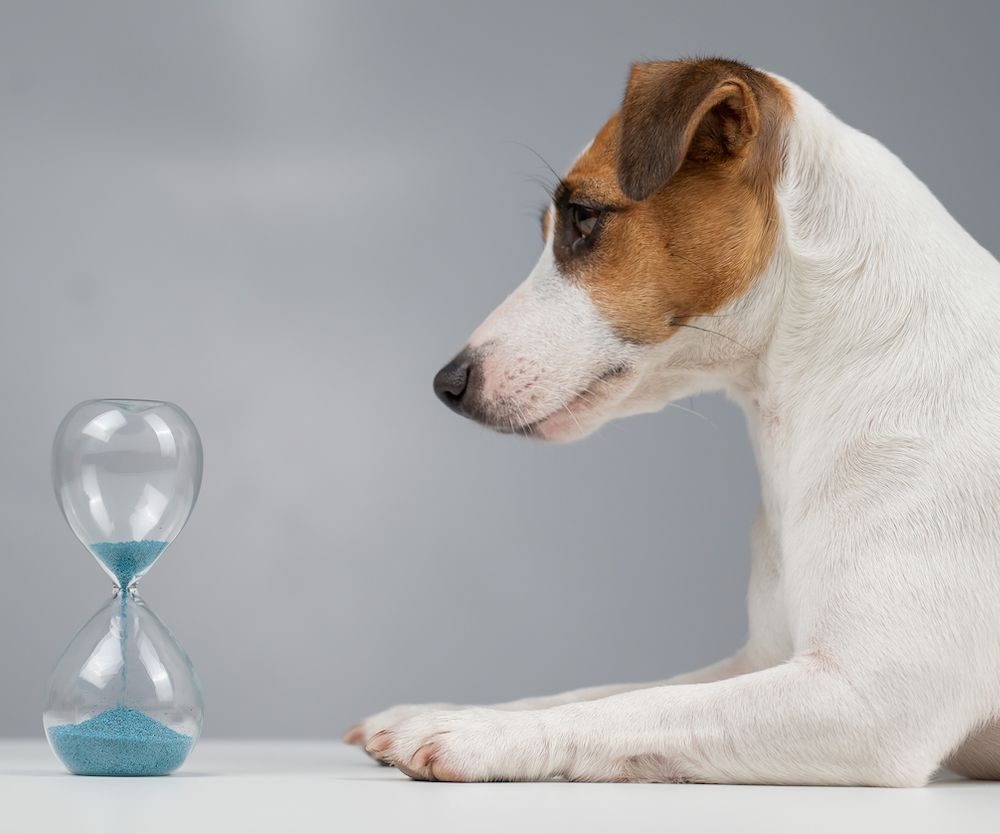
 Time travel and the ability to change things already done has been an idea that has fascinated mankind probably ever since we contemplated the concept of time. Notice, I did not say since we understood the concept of time, because there are serious differences of opinion by scientists about how time is constructed.
I am not as scientifically gifted as Sheldon on Big Bang Theory, so I had to ask Google to explain Einstein’s concept of time — and the possibility of time travel: His idea was that, theoretically, the closer we come to traveling at the speed of light (186,000 miles per second), the more time would appear to slow down for us from the perspective of someone who, in relation to us, was not moving. He called the slowing of time due to motion “time dilation.”
Confused? Me, too. So, let’s see if I can simplify this. In the 1978 movie Superman, in order to save Lois Lane, who had just been buried in an avalanche, Superman flies into orbit and begins flying around the Earth counter-rotationally, reaching his maximum speed in about eight seconds, thus having the earth rotate backward, causing time to run backward, and he was able to save Lois before the avalanche buried her. Whew, I’m glad he got there in time. Christopher Reeve must be a believer in time travel, because in 1980 he was the male lead in one of my all-time favorite movies, Somewhere in Time, in which he travels back in time to be with the love of his life.
It appears that Hollywood was a little behind the times (no pun intended) because H.G. Wells was way ahead of them. The Time Machine (also marketed as H. G. Wells' The Time Machine) is a 1960 post-apocalyptic science-fiction film based on the 1895 novella of the same name. However, this time, the protagonist’s travel was to the future — and it was not a pretty sight.
Time travel has even been romanticized in our music. In 1973, Jim Croce released his famous song Time in a Bottle, whose opening lyrics are:
If I could save time in a bottle
The first thing that I'd like to do
Is to save every day 'til eternity passes away
Just to spend them with you
Not to be outdone, one of the greatest entertainers of all time, Cher, released If I Could Turn Back Time in 1989:
If I could turn back time
If I could find a way
I'd take back those words that have hurt you
And you'd stay
I hope you have found this introduction of the concept of time travel interesting, but perhaps you are saying what does that have to do with me?
Well, if you could go back in time, what are some of the things you might change? Let me give you some examples.
Recently, as part of my assignment at an all-breed show, I judged an entry of a Sporting breed.
To be honest, I was extremely disappointed in the quality of this entry. My inner self was screaming at me to withhold any points, but I wound up telling myself that I may have withheld points too often, and so I just pointed my finger and unhappily moved on to the next breed.
I certainly have had enough time for this feeling to pass, but obviously it has not. I knew what the right thing to do was, and I was — and am — very disappointed at my lack of integrity to just let this go on. I told myself it was just one point, but that should not matter.
Many judges would say, “Just move on.” Obviously, I can’t do that because it still bothers me. Like most of my peers, I take my “job” very seriously, and I know that part of my job is to protect the breed in front of me — and I did not do that. My conscience has me paying a penance now, and I wish I could turn back the clock and do what I should have done. Whether it is measuring, weighing or withholding, if it is the right thing to do, a judge has to do it.
The Back to the Future collection of films was first introduced in 1985, and as a friend suggested, it should make me think about what our future will be. There is a great deal of strength, knowledge and passion in our dog community, but there are also those — breeders exhibitors, handlers, judges and maybe even the AKC — who allow the bar of quality to be lowered, and care only about winning those pieces of cloth and rankings. This is why I am beating myself up so much about not doing the right thing when I judged that breed poorly because I did not withhold. If we continue to lower the bar of quality, what will it even mean to have a purebred dog? Will dog shows continue to have any real value, or will we all just put judges in the center of the ring to pass out ribbons like a Pez dispenser? Shame on all of us if we allow this to happen.
What else would I turn back the clock to change?
I would like to go back in time and change the “courtesy turn” that we taught in handling classes. This maneuver has gone way too far. Probably everyone has taught our Juniors and new exhibitors to make what we call a courtesy turn before moving on the “down and back.” I have had exhibitors turn three or four times before starting out. All that accomplishes is getting the handler, judge and dog dizzy. Sometimes, especially with big breeds, all that is necessary is to get you and the dog lined up in the right direction and then go. I promise, no judge will feel slighted that you did not do a courtesy turn. Juniors will probably continue doing this because that is how they are taught and some judges will expect it, but let’s not go overboard. It is much more important to just get yourself — and your dog — lined up and move straight. Line yourself up with a ring stanchion or another “landmark,” and go.
I have very real great respect for our breeders. I managed to breed a few champions in three different breeds, but breeding was not my strength. I had purchased an excellent bitch — the wonderful Ch. Bayberry Sonnet — to be my foundation breeding bitch when she was done with her very successful show career. When she was diagnosed with pyometra it tore my heart out because at that time it was “spay her or lose her.” Not only did this cut her show career short, it absolutely destroyed my zest for breeding. So, when I see those who consistently produce quality, I have great respect for them, because I know they have gone through some difficult times and persevered. If I could go back in time, I would tell THAT Sid Marx to “put your big boy pants on and move on. Get another quality bitch and try again.”
There was a time that I was very much on the fast track to becoming an all-breed judge, but I got so angry at a particular AKC conformation representative that — after telling her where the sun wasn’t shining — I took a few years away from dog shows. What caused this? After judging an entry of English Cocker Spaniels, this AKC representative asked me how I could give Best of Breed to a particular dog because he had a bad temperament. I said I didn’t see him do anything in the ring that indicated this, and she said, “Everyone knows about it.” So, she expected me to know what “everyone knew” and not award this dog even though he had done absolutely nothing in or outside the ring on this day I was judging. It was then that I said goodbye, because people like this had too much power.
A few years later, there was a show near where I lived, so I decided to go watch. One of the judges was Anne Rogers Clark, and she came over to me and asked why I wasn’t judging anymore. I told her the story, and she reminded me that I couldn’t help dogs or their breeders by staying away, and if I truly loved the dogs — as I said I did — I would get back into the ring. So, I did.
In all likelihood, I probably would have had enough time to become an all-breed judge, but that’s not the path I had chosen. If I could go back in time, I probably wouldn’t let that one person get me so angry that I reacted poorly, but I still don’t think I would have tried to be an all-breed judge because there are some breeds that I wouldn’t want to judge, and I don’t believe that anyone can know all the nuances that are necessary to judge all breeds properly.
What do you think?